The 8 Best AI Voice Agents for Businesses in 2026: Reviewed & Compared
Our Top Picks
The best AI voice agent depends on whether you need to automate inbound support, qualify leads, or run outbound campaigns, and whether you want a ready-to-use platform or a customizable solution.
Our top 4 at a glance:
- CloudTalk: Best all-in-one AI voice agent for teams
- Retell AI: Best for building your own AI voice agent
- ElevenLabs: Best low-cost option for getting started
- Bland AI: Best for high-volume outbound teams that want one flat per-minute rate
According to Salesforce, by 2027, AI is expected to handle half of all customer service cases, up from 30% today.
Is your team ready for that shift? AI voice agents can answer calls, qualify leads, and handle routine requests around the clock, giving your team more time for complex conversations.
But the right tool depends on your needs. In this article, we compare the 8 best AI voice agents by features, pricing, integrations, and use cases to help you find the right fit.

Stop sending callers to voicemail

8 Best AI Voice Agents: Side-by-Side Comparison
Best AI Voice Agents Comparison Table
| Tool | Voice quality | Latency | Setup | Phone service | Starting price | G2 rating |
|---|---|---|---|---|---|---|
| CloudTalk | Natural-sounding, 70+, auto-detected | <800 ms | Minutes for simple workflows; 1–2 weeks for more complex ones | Built-in, 160+ countries | $99/month (200 minutes) | 4.4/5 |
| Synthflow | Highly natural and human-like voice quality | <500ms | For self-serve <1 hour; for enterprise 4-8 weeks | Built-in, or your own carrier | Custom; from $30,000/year for enterprise | 4.5/5 |
| Retell AI | High and natural-sounding | ~600ms | Less than 15 minutes; takes weeks for more complex workflows | Retell numbers or your own carrier | $0.07 to $0.31/min | 4.8/5 |
| Bland AI | Professional and highly customizable; supports voice cloning | ~400ms | Low-code, developer-focused, from 10 minutes to 2–4 weeks | Bland number or your own SIP | $0.14/min | 5/5 |
| Vapi | Depends on your voice provider | Depends on your providers | API build; needs developers | Vapi numbers or your own carrier | $0.05/min;$29/month | 4.2/5 |
| PolyAI | Exceptionally lifelike and natural | <300ms | Built and maintained by PolyAI | Your existing contact center | Contact sales | 5/5 |
| ElevenLabs | 10,000+ voices, voice cloning, expressive mode | ~75 ms-100ms;depend on model | No-code builder or APIs; you connect telephony | Your own carrier | Free; from $1/month | 4.5/5 |
| Sierra | Handles interruptions and background noise | Not published | Enterprise sales cycle | Integrated with your telephony infrastructure | Contact sales | 4.5/5 |
How We Chose the Best AI Voice Agents
We evaluated each tool against the criteria that matter most to businesses, including features, usability, integrations, and pricing. We reviewed each tool’s public documentation and pricing page, and used G2 ratings where available. This gave us a consistent basis for comparing the tools and highlighting their main strengths and limitations.
We compared the best AI voice agent platforms on eight criteria:
- Conversation quality: natural speech, accent handling and the speed of the first reply.
- Human handoff: a transfer that carries the context of the call, plus a fallback when nobody answers.
- Phone system fit: numbers in your countries, call quality, and whether it works with your current setup.
- Integrations: native CRM, helpdesk and calendar connections, plus webhooks and an API.
- Setup and ownership: a no-code or developer build, and who maintains the agent afterwards.
- Pricing and value: published prices, included minutes, minimum billing and any free tier.
- Security and compliance: SOC 2, ISO 27001, GDPR, a HIPAA path where you need one, and consent tools for outbound calls.
- Analytics and support: recordings, transcripts and summaries, help during setup, and review ratings.
1. CloudTalk: Best for Running AI and Human Calls on One Phone System
Why We Picked It
CloudTalk is a calling platform that built its telephony first—including numbers, routing, call quality, CRM integrations, and coverage in 160+ countries—and then put AI inside the call flow. The CloudTalk AI Receptionist works as your front desk, while the AI Specialist runs defined workflows from start to finish.
This makes it a good fit for teams that want AI voice automation without the complexity of developer-led tools. You can build call flows without code, connect AI to your existing business systems, and keep human handoffs and routing rules within the same phone platform. It also offers more control over how AI handles calls, which can help teams balance automation with the quality and brand experience they expect.
We also use CloudTalk’s AI Voice Agent ourselves. In one experiment, it contacted 6,531 overlooked leads, held 997 conversations, and generated €12.8K in SQL value, delivering a reported 17× ROI.
"They’re answering. That was the moment we realized this could actually work, leads we thought were dead were picking up the phone and talking to us."
What Are CloudTalk's Key Features?
- 24/7 inbound and outbound calling: Handle inbound calls around the clock and run outbound workflows for lead qualification, reminders, renewals, and reactivation.
- Answers based on your business data: Use information from uploaded documents to answer questions, qualify callers, and book meetings directly into your calendar.
- Smart routing and human handoff: Route calls by intent and transfer them to the right person or team with the conversation context intact.
- Deep CRM and business integrations: Connect with HubSpot, Salesforce, Pipedrive, Zoho, and 100+ more, with webhooks and API triggers through tools like Zapier and Make.
- 70+ languages: Automatically detect the caller's language, making it suitable for businesses serving customers across different countries.
- Flexible call flows: Add AI to the Call Flow Designer to handle specific scenarios such as after-hours or overflow calls, while keeping AI and human calls in the same analytics view.
- Enterprise-grade security: SOC 2 Type 2 audited, ISO/IEC 27001:2022 certified, and GDPR compliant, with documentation available in the CloudTalk Trust Center.
What Is the Pricing of CloudTalk?
- AI Receptionist (inbound): from $99/month for 200 minutes.
- AI Specialist (inbound + outbound): from $349/month for 1,000 minutes.
- Phone system: from $25/user/month-
See full CloudTalk's AI voice agent pricing breakdown.
Free trial: Yes, 14 days and 50 free AI minutes, no credit card required.
What Does CloudTalk Integrate With?
CloudTalk integrates with 100+ business tools, covering CRM, customer support, sales, and automation.
- CRM: HubSpot, Salesforce, Pipedrive, Zoho CRM
- Customer support: Zendesk, Intercom, Freshdesk, Help Scout
- Sales: Gong, Outreach, Salesloft, Modjo
- Automation: Zapier, Make, Pabbly
What We Like vs. What to Consider
| What We Love | What to Consider |
|---|---|
| No-code setup — Simple workflows can go live in minutes | Voice-first — Not a full omnichannel suite; email, chat, and video require separate tools |
| AI + telephony in one platform — no need to bolt an AI agent onto a separate phone system | Built for teams — Solo users may not need its full collaboration and routing capabilities |
| Natural, fast conversations — especially important for avoiding the robotic experience | Cloud-based onlys — Designed for cloud phone systems rather than on-premises PBX hardware |
What Do Customers Say About CloudTalk?
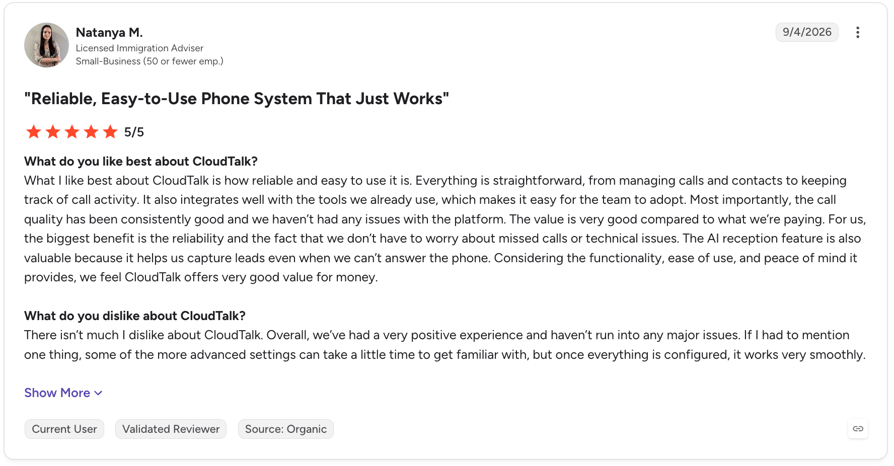
Customers highlight reliability, ease of use, and call quality, as well as the value of having integrations and telephony built into the same platform. AI users particularly praise its fast, natural-sounding conversations, multilingual capabilities, and ability to capture leads when teams can’t answer.
G2 Rating: 4.4/5 (1938+ reviews)
2. Synthflow: Best for Mid-Size and Enterprise Contact Centers That Want a Managed No-Code Rollout
Why We Picked It
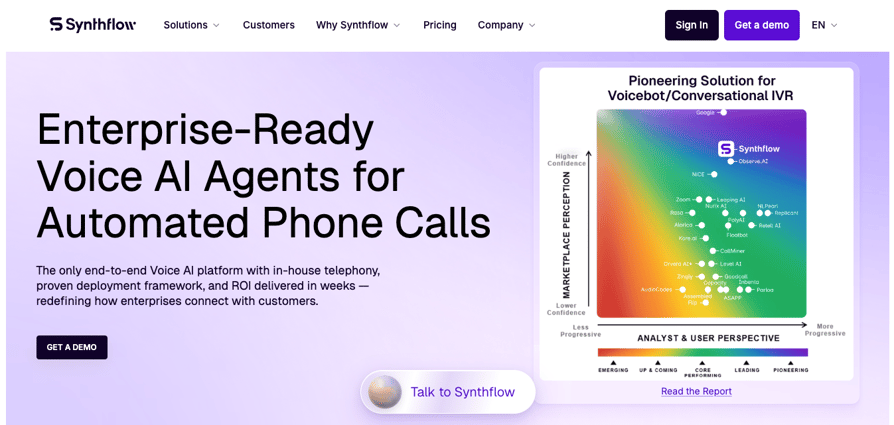
If you’ve read about AI voice agents before, Synthflow will probably look familiar. We picked it as a strong fit for enterprises that want to deploy voice AI at scale, combining no-code setup, quick deployment, strong integrations, and natural-sounding voices.
Its in-house telephony and deployment support also make it a better fit for larger teams that need more control, reliability, and support than a typical self-serve voice AI tool offers.
What Are Synthflow's Key Features?
- In-house telephony: Use Synthflow’s own network or connect your existing carriers and SIP trunks, with control over routing, quality, and compliance.
- Visual flow builder: Build no-code workflows for routing, bookings, FAQs, lead qualification, and other business processes.
- Testing and monitoring: Test agents before launch and monitor live calls with real-time analytics and automated QA. 200+ integrations: Connect voice agents to CRMs, CCaaS platforms, calendars, and other business tools, including HubSpot, Salesforce, and Zapier.
- Enterprise deployment: Forward-deployed engineers help launch and scale agents, with support from pilot to production in weeks.
What Is the Pricing of Synthflow?
Enterprise contracts start at $30,000 a year. Building is free, and launched agents are billed pay-as-you-go at an unpublished rate. Read our Synthflow pricing guide for a closer look at how pricing works.
What Does Synthflow Integrate With?
Synthflow connects with 200+ business tools, covering telephony, CRM, contact centers, sales, customer support, and automation.
- CRM: HubSpot, Salesforce, Pipedrive, Zoho, GoHighLevel
- CCaaS & telephony: RingCentral, Genesys, 8x8, Twilio, Telnyx
- Sales & support: Gong, Outreach, Intercom, Zendesk
- Automation & developer tools: Zapier, Make, n8n, Bubble
- Calendars & commerce: Google Calendar, Cal.com, Stripe, Shopify
What We Like vs. What to Consider
| What We Like | What to Consider |
|---|---|
| No-code builder — Makes it easier to build and launch voice agents without coding. | Less flexibility for highly custom use cases than developer-first platforms. |
| In-house telephony — Gives enterprises more control over call quality, routing, and infrastructure. | Pricing can add up as call volume and usage increase. |
| Enterprise deployment support — Forward-deployed engineers help take agents from pilot to production. | More enterprise-focused — Less suited to teams looking for a simple self-serve tool. |
What Do Customers Say About Synthflow?
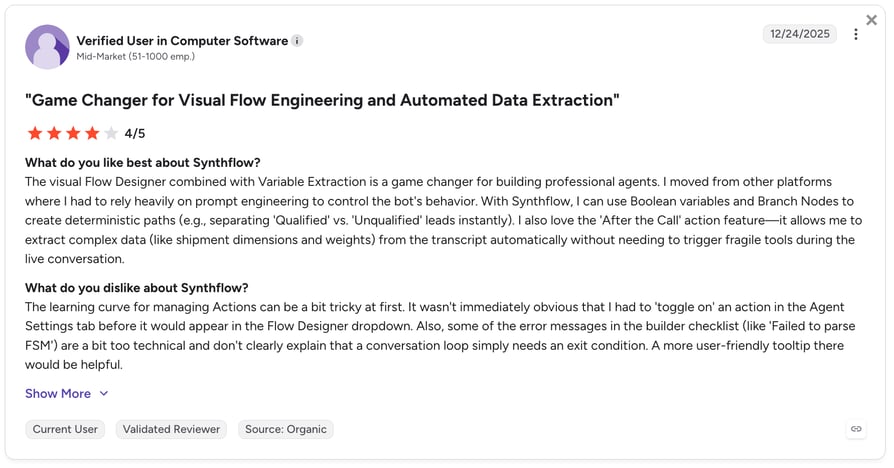
Synthflow customers consistently highlight fast deployment but also point to two key limitations: a learning curve when moving beyond simple setups and a ceiling on advanced customization.
G2 Rating: 4.5/5 out of 1,015+ reviews.
3. Retell AI: Best for Technical Teams That Want a Visual Builder With Pay-As-You-Go Pricing
Why We Picked It
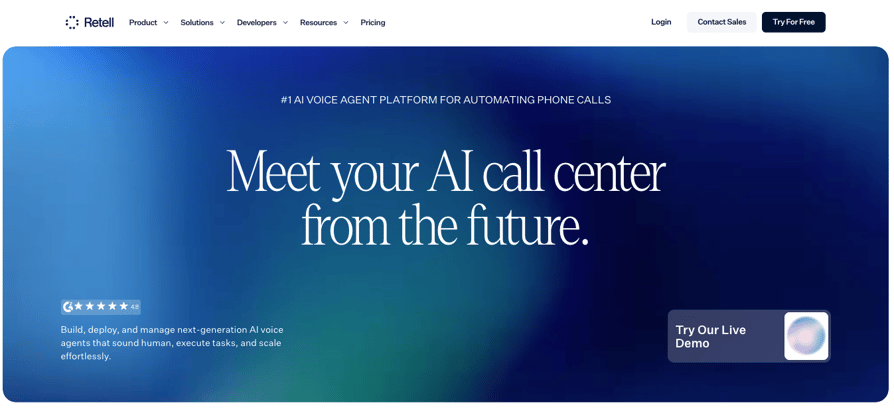
Retell AI is the best fit for technical teams that want to build and customize their own AI voice agents. It combines a visual builder with an API, so teams can get started quickly while still having control over how their agents work.
It also stands out for its clean interface, fast setup, natural-sounding conversations, low latency, and integrations, making it easy to test, iterate, and connect agents to existing workflows.
What Are Retell AI's Key Features?
- Visual voice agent builder: Build call flows with transfers, DTMF, SMS, and other actions without coding everything from scratch.
- Inbound and outbound calling: Handle incoming calls or run batch outbound campaigns with branded caller ID.
- Call simulation and testing: Test agents before going live and iterate on prompts, workflows, and call behavior.
- Post-call analysis and AI QA: Review calls with automated analysis and quality checks to spot issues and improve agent performance.
- Integrations and human handoff: Connect Retell AI to HubSpot, Zoho, GoHighLevel, Zapier, Make, and other tools through its API. Agents can also transfer calls to humans with an AI-generated briefing.
What Is the Pricing of Retell AI?
Retell AI pricing includes two plans:
- Pay-as-you-go, $0.07-$0.31/minute depending on model and volume.
- Custom enterprise pricing available.
What Does Retell AI Integrate With?
Retell AI connects with CRMs, telephony providers, automation platforms, and other business tools, with native integrations, APIs, and third-party connectors.
- CRM: HubSpot, Salesforce, Zoho CRM, GoHighLevel, Microsoft Dynamics 365
- Telephony: Twilio, Vonage, Telnyx, Five9
- Automation: Zapier, Make, n8n, viaSocket
- Calendars & business tools: Calendly, Cal.com, Google Workspace, Zendesk
What We Like vs. What to Consider
| What We Like | What to Consider |
|---|---|
| Transparent pricing — Published per-component rates make it easier to estimate costs before you start. | Real cost depends on your stack — Telephony, LLM, and other components can add to the per-minute cost. |
| Strong build and testing tools — Visual workflows, call simulation, batch calling, and AI QA make it easy to test and iterate. | More technical setup — Getting the most out of Retell can require some technical knowledge, especially for custom workflows. |
| Flexible and customizable — An API, custom LLM support, and integrations give technical teams plenty of control. | 24/7 support is Enterprise only — Smaller teams may have more limited support options. |
What Do Customers Say About Retell AI?
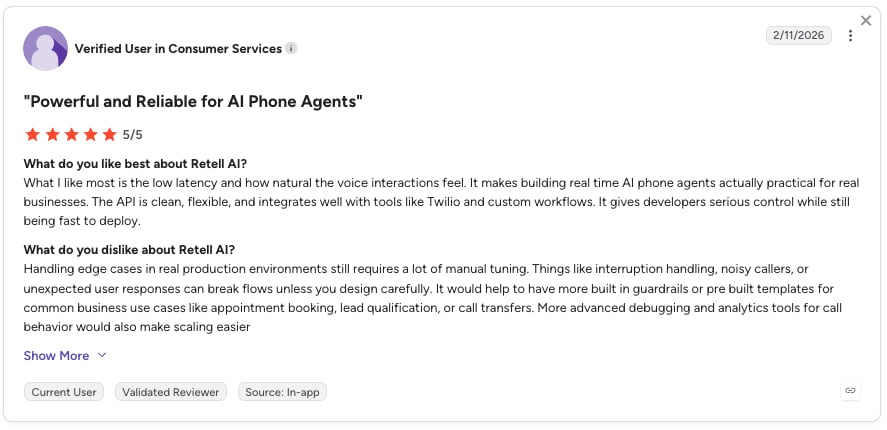
Retell AI customers highlight that they can go from idea to a working voice agent quickly, thanks to an intuitive interface and clear workflow builder, but note the platform struggles with highly complex or dynamic conversational logic compared to more developer-first tools.
G2 Rating: 4.8/5, out of 2,640+ verified user reviews.
4. Bland AI: Best for High-Volume Outbound Teams That Want One All-In Per-Minute Rate
Why We Picked It
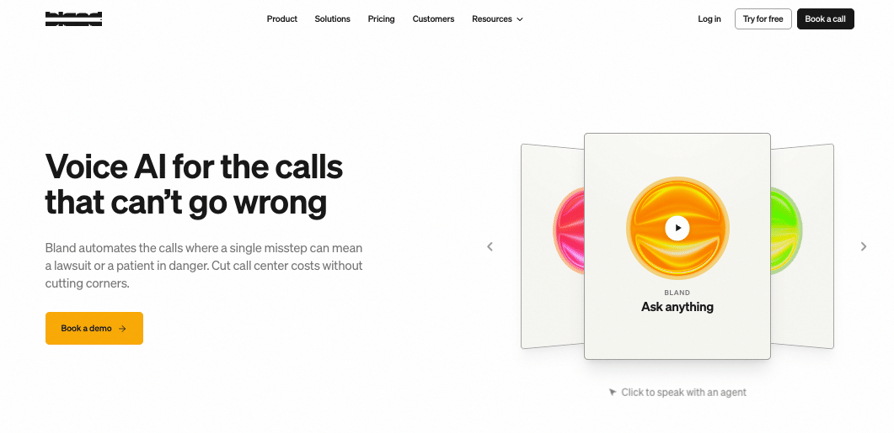
Bland AI is best fit for high-volume outbound and regulated teams that want predictable, all-in pricing without piecing together separate voice, telephony, and AI providers. Its own infrastructure also gives teams more control over how agents are deployed, including self-hosting options.
We also picked Bland for its low latency, conversational voice, and flexibility. It supports both simple and complex workflows, while its API and custom code options give technical teams plenty of room to build around their existing systems.
What Are Bland AI's Key Features?
- Pathways builder: Create visual call flows with branching logic, variables, and custom actions for more predictable conversations.
- Edge-case testing: Test different scenarios before going live to catch issues and fine-tune how agents respond.
- Outbound AI agents: Automate qualification, follow-ups, reminders, and other high-volume outbound workflows.
- Inbound and outbound calling: Handle both incoming and outgoing calls, with support for routing, voicemail, and custom call flows.
- Human handoffs: Transfer calls to people with the relevant conversation context, using warm or live transfers.
What Is the Pricing of Bland AI?
Bland AI pricing includes three pricing plans:
- Start: $0.14/min
- Build: $0.12/min + $299/month platform fee
- Enterprise: Custom.
What Does Bland AI Integrate With?
Bland AI connects with CRM, telephony, scheduling, messaging, and automation tools, with a REST API and webhooks for custom integrations.
- CRM: Salesforce, HubSpot
- Telephony & contact centers: Twilio, SIP, Genesys, Five9, NICE CXone, Amazon Connect, Talkdesk
- Scheduling: Calendly, Cal.com
- Automation: Zapier, Make, Pipedream
- Messaging & collaboration: Slack, Notion, SMS & RCS, iMessage
What We Like Vs. What to Consider
| What We Like | What to Consider |
|---|---|
| All-in-one pricing — One per-minute rate covers the AI, voice, and telephony. | Limited model choice — You can only use Bland's own models, so you can't switch to a third-party model if you prefer its performance or pricing. |
| Self-hosting options — Gives teams more control over deployment and infrastructure. | Some key features require Enterprise — Warm transfers, SMS, web chat, and custom dialing are only available on Enterprise. |
| Flexible workflows — Pathways, APIs, and custom code give technical teams more control over agent behavior. | he Start plan is mainly for testing — Limited calls, concurrency, voices, and knowledge bases make it less suitable for larger production setups. |
What Do Customers Say About Bland AI?
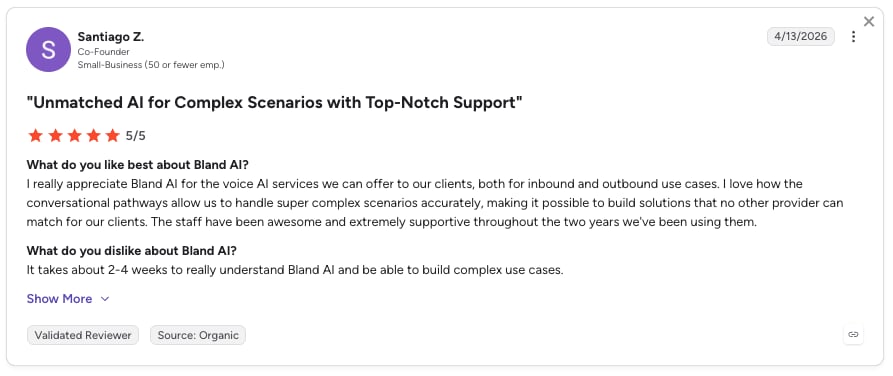
Bland AI customers highlight its ease of use and powerful conversational voice capabilities, but note a learning curve and complexity when moving beyond basic use cases.
G2 rating: 5/5, based on 11+ verified user reviews.
5. Vapi: Best for Engineering Teams That Want to Choose and Swap Every Model
Why We Picked It
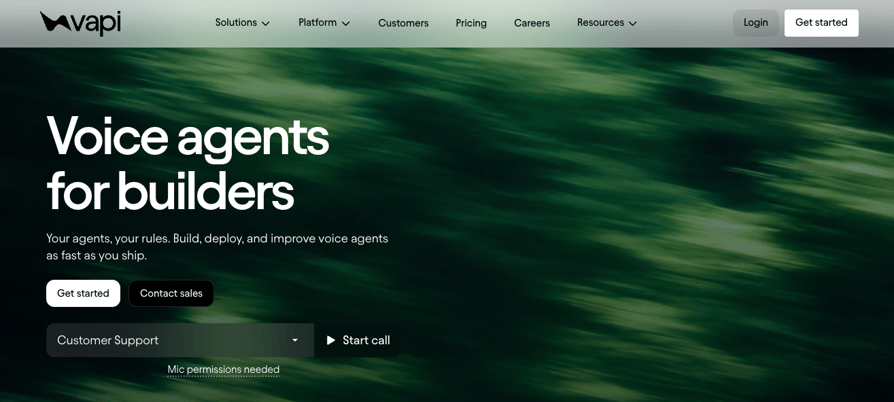
Vapi is the best fit for engineering teams that want full control over their voice AI stack. You can choose and swap the speech-to-text, language model, and voice providers behind your agents instead of being locked into a single vendor.
We also picked Vapi for its developer-friendly approach and flexible pricing. Its API-first platform gives technical teams the control to build custom voice agents around their existing stack, while passing model costs through at cost makes it easier to choose the providers that fit their needs and budget.
What Are Vapi's Key Features?
- Swappable AI providers: Choose and switch speech-to-text, language model, and voice providers to balance latency, quality, and cost.
- Inbound and outbound calling: Handle incoming calls or run programmatic outbound campaigns at scale.
- Transfers and handoffs: Build transfers and warm transfers directly into your voice agents, including handoff context.
- API-first integrations: Connect your own Twilio, Telnyx, or SIP setup, and integrate with tools like Make, n8n, and GoHighLevel. CRMs can connect via API or webhooks.
- Enterprise controls: Use SSO, role-based access control, guardrails, and vendor-stated SOC 2, HIPAA, and PCI compliance.
What Is the Pricing of Vapi?
Vapi pricing is usage-based, with a $0.05/min hosting fee plus AI model and telephony costs. You can start without a monthly plan or add a Success Package for additional support and platform features.
- No Success Package: $0/month
- Core: $29/month
- Pro: 10% of Vapi's hosting fee, with a $999/month minimum
- Premier: Custom pricing
- HIPAA compliance: $2,000/month add-on
What Does Vapi AI Integrate With?
Vapi connects with telephony providers, automation tools, and business systems, but CRM integrations typically require API or webhook work rather than ready-made native connectors.
- Telephony: Twilio, Telnyx, SIP
- CRM & sales: GoHighLevel, Salesforce, HubSpot
- Automation: Make, n8n, Zapier
- Business tools: Calendars, databases, and other systems via API or webhooks
What We Like Vs. What to Consider
| What We Like | What to Consider |
|---|---|
| Maximum control over providers — Choose and swap the models, voices, and telephony providers behind your agents. | Costs stack across providers — Your final cost includes Vapi's hosting fee plus the AI and telephony providers you use. |
| Public cost calculator — Estimate your monthly costs based on call volume and the providers you choose. | Support depends on your plan — Dedicated support and faster response times are reserved for higher Vapi tiers. |
| API-first flexibility — Build custom workflows and connect Vapi to your existing stack through APIs and webhooks. | Human handoff requires more setup — Connecting agents to human reps requires custom configuration and development work. |
What Do Customers Say About Vapi?
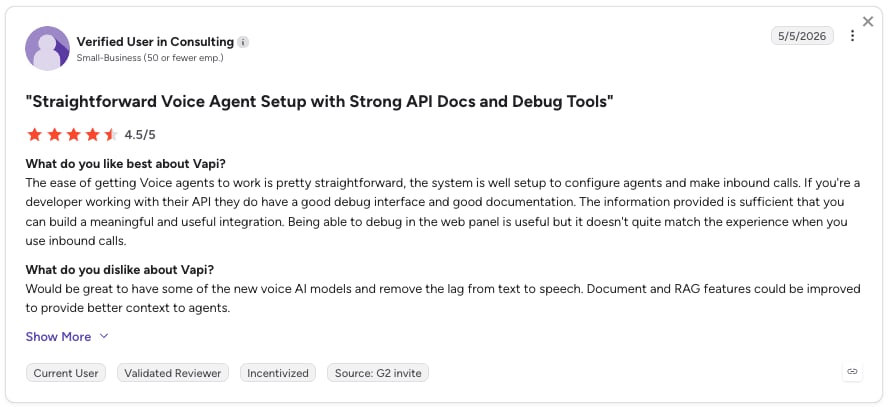
Vapi customers highlight ease of setup and flexibility for building voice AI agents, but report issues with latency, unreliable performance, additional costs, and inconsistent support.
G2 rating: Vapi has limited G2 review volume just three reviews with a 4.2/5 rating, since it's a developer-focused API.
6. PolyAI: Best for Large Enterprises That Want Multilingual Voice Agents Built and Run for Them
Why We Picked It
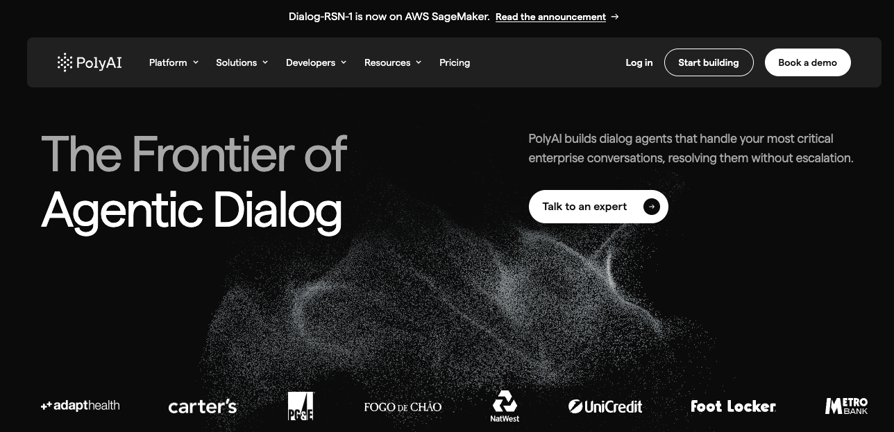
PolyAI is a strong fit for large enterprises handling high volumes of complex customer calls. Its natural-sounding, multilingual agents can resolve routine requests and manage complex conversations across 75+ languages.
We also selected PolyAI for its enterprise-grade support and ongoing maintenance, included in its per-minute pricing. However, custom rates and the need for separate telephony make costs harder to predict.
What Are PolyAI's Key Features?
- Natural, human-like conversations: Handle multi-turn conversations, interruptions, accents, and complex customer requests.
- Complex call resolution: Automate authentication, billing, bookings, and troubleshooting, with handoffs to human agents when needed.
- Agent Studio and developer tools: Build agents with a low-code/no-code interface or customize them using APIs and the Agent Development Kit (ADK).
- Enterprise integrations and multilingual support: Connect with platforms like Genesys, Five9, Salesforce, and HubSpot, with support for 75+ languages.
- Enterprise security and managed support: Includes PII redaction, human-in-the-loop controls, ongoing monitoring, maintenance, and upgrades, alongside SOC 2 Type II, ISO 27001, PCI DSS, and GDPR compliance.
What Is the Pricing of PolyAI?
PolyAI charges per minute but doesn't publish the price, so you should contact sales. Our PolyAI pricing guide explains what to expect.
What Does PolyAI Integrate With?
PolyAI offers 130+ integrations across telephony, CRM, knowledge management, collaboration, and industry-specific systems. It also supports custom integrations through APIs and its Agent Development Kit (ADK).
- Telephony and contact centers: Genesys, Five9, Amazon Connect, RingCentral, Talkdesk, Twilio
- CRM and customer support: Salesforce, HubSpot, Microsoft Dynamics, ServiceNow, Zendesk, Freshdesk
- Productivity and collaboration: Google Workspace, Microsoft 365, Slack, Notion, Zoom, Confluence
- Industry-specific tools: OpenTable, SevenRooms, Amadeus, athenaOne, Guidewire, Stripe
What We Like Vs. What to Consider
| What We Like | What to Consider |
|---|---|
| Natural, human-like voice — Handles interruptions, accents, and complex conversations naturally. | No public pricing — You need a custom quote to estimate costs and compare plans. |
| Enterprise-grade security — Supports SOC 2 Type II, ISO 27001, HIPAA, GDPR, and PCI DSS. | Telephony isn’t included — You need an existing contact center or telephony provider. |
| 130+ integrations — Connects with major CRM, contact center, and industry-specific tools. | Enterprise-focused rollout — Production deployments can take around six weeks, according to PolyAI. |
What Do Customers Say About PolyAI?
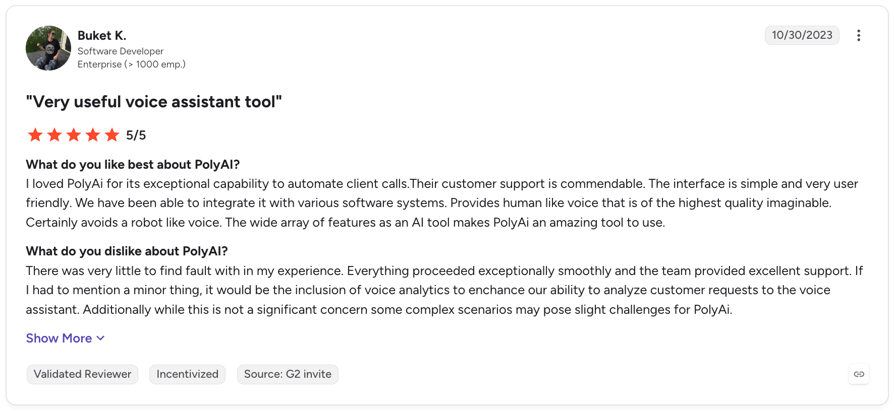
PolyAI gets very positive feedback. Users praise its natural-sounding voice, conversational quality, and ability to automate routine calls. The main drawbacks are occasional lag and limited voice analytics.
G2 rating: 5/5 out of 12 reviews.
Recommended Reads
7. ElevenLabs: Best for Brands That Care Most About Voice Quality and a Low-Cost Start
Why We Picked It
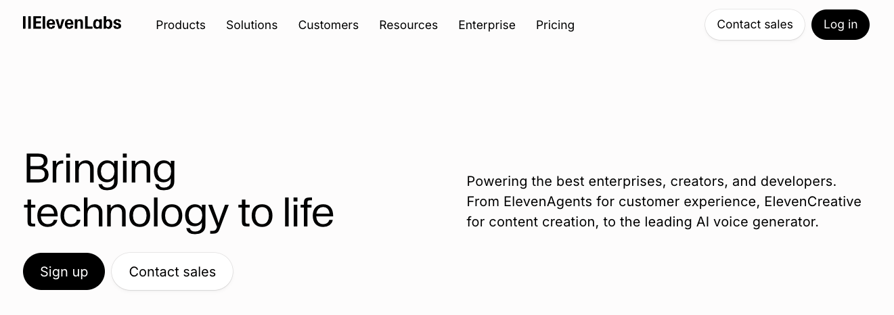
ElevenLabs is a strong fit for teams that prioritize voice quality and want an affordable way to get started. Its realistic, expressive voices, large voice library, and voice cloning tools make it easy to create agents that sound natural.
Its simple setup and flexible APIs let teams build agents with or without code. However, you'll need separate telephony to handle phone calls, and usage-based pricing can become harder to predict as volume grows.
What Are ElevenLabs' Key Features?
- 10,000+ voices and voice cloning: Choose from a large voice library or create custom voices for your brand.
- No-code builder and knowledge base: Build agents visually and give them access to your business information.
- Expressive conversations: Adapt delivery to the caller's tone, including frustration, for more natural interactions.
- Inbound and outbound calling: Handle both call types through connected telephony providers, including Twilio, Genesys, Telnyx, and SIP.
- Context-aware human handoffs: Transfer calls to human agents with conversation context. Supports 90+ languages and enterprise security standards, including SOC 2 Type II, ISO 27001, HIPAA, and PCI DSS on Enterprise.
What Is the Pricing of ElevenLabs?
ElevenLabs pricing ranges from $0/month on the Free plan to $990/month on Business:
- Free: $0/month
- Starter: $1 for the first month, then $6/month
- Creator: $11 for the first month, then $22/month
- Pro: $99/month
- Scale: $299/month
- Business: $990/month
- Enterprise: Custom pricing
What Does ElevenLabs Integrate With?
ElevenLabs integrates with CRMs, telephony providers, automation platforms, and business tools to connect voice agents to existing workflows.
- CRM: Salesforce, HubSpot, Zoho, Pipedrive
- Telephony and contact centers: Twilio, Genesys, RingCentral, Vonage, Telnyx, Amazon Connect, SIP trunking
- Automation: Zapier, Make, n8n
- Customer support: Zendesk, ServiceNow
- Scheduling and communication: Calendly, Cal.com, Slack, Mailchimp, DocuSign
- Payments and ecommerce: Stripe, Shopify
- Data and AI infrastructure: Airtable, Palantir Foundry, Together AI, Groq Cloud
What We Like Vs. What to Consider
| What We Like | What to Consider |
|---|---|
| Natural-sounding voices — Realistic, expressive speech makes conversations feel more human. | Extra costs add up — LLM usage and telephony are billed separately from the subscription. |
| Easy no-code setup — Teams build agents without engineering work. | Email-only support — Faster or dedicated support requires an Enterprise plan. |
| Strong multilingual support — Supports a wide range of languages for international customer interactions. | Not a complete calling platform — Routing, analytics, and telephony require separate tools. |
What Do Customers Say About ElevenLabs?
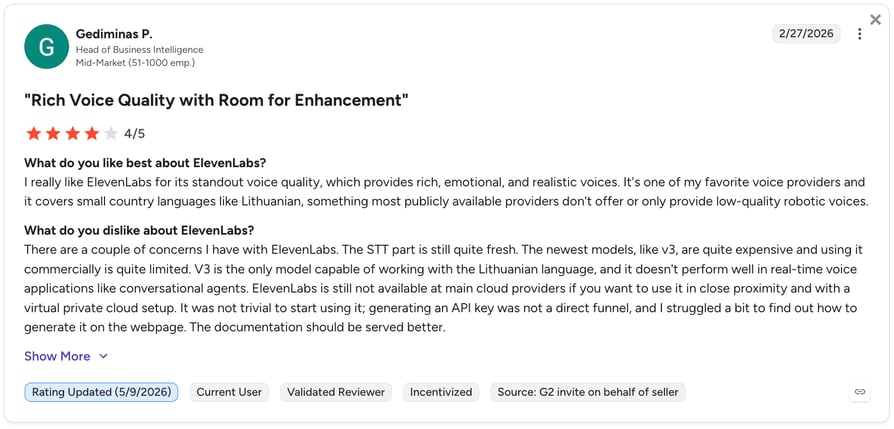
Customers praise ElevenLabs’ ease of use and realistic voices, but pricing is a recurring complaint. The word “expensive” appears 171 times in G2 reviews, with another 148 mentions of pricing-related issues.
G2 rating: 4.5/5 out of 1,252 reviews.
Recommended Reads
8. Sierra: Best for Large Consumer Brands That Want One Agent Across Voice and Chat With Outcome-Based Pricing
Why We Picked It
Sierra is a strong fit for large consumer brands that want to automate customer service across multiple channels. Its AI agents handle conversations across voice, chat, SMS, WhatsApp, and email, helping businesses deliver a more consistent customer experience.
Its outcome-based pricing ties costs to resolved customer interactions rather than call minutes. However, its enterprise focus and custom pricing may lead smaller teams to look for a Sierra AI alternative.
What Are Sierra's Key Features?
- Natural voice conversations: Handle interruptions and background noise for smoother customer interactions.
- Omnichannel AI agents: Manage conversations across voice, chat, SMS, WhatsApp, email, and ChatGPT.
- Inbound and outbound calling: Handle incoming and outgoing calls, with full conversation context passed to human agents during handoffs.
- Payments by phone: Accept card and ACH payments through voice interactions.
- Testing and enterprise security: Use testing tools and supervisor models to reduce hallucinations, with support for 55+ languages and certifications including SOC 2, HIPAA, PCI DSS Level 1, FedRAMP High, and ISO 27001.
What Is the Pricing of Sierra?
Sierra doesn't publish a price, so you'll need a quote. Our Sierra pricing guide covers the outcome-based model.
What Does Sierra Integrate With?
Sierra connects with enterprise systems, contact center platforms, payment providers, and business data sources. Its partner ecosystem includes:
- Contact centers and telephony: Amazon Connect, Five9, Genesys, Twilio
- Cloud and AI platforms: AWS, Google Cloud, OpenAI, Anthropic
- Payments and financial services: Plaid
- Healthcare systems: athenahealth
- Enterprise services: Oracle, Oracle Hospitality
What We Like Vs. What to Consider
| What We Like | What to Consider |
|---|---|
| Outcome-based pricing — Pay for resolved customer interactions rather than call minutes. | No public pricing or free trial — You’ll need to contact Sierra to discuss costs and evaluate the platform. |
| Built-in voice payments — Accept card and ACH payments during calls. | Enterprise-focused platform — May offer more than smaller teams need. |
| Omnichannel AI agents — Manage customer conversations across voice, chat, SMS, WhatsApp, and email. | Not a complete telephony system — You may need a separate contact center or telephony provider to handle calls. |
What Do Customers Say About Sierra?
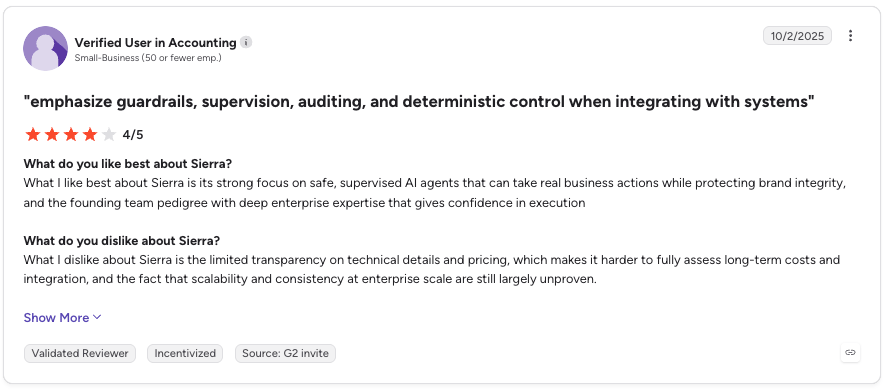
Customers praise Sierra for its natural conversations, ease of use, and seamless integrations. Common criticisms include limited customization, pricing transparency, and the need for human intervention in more complex conversations.
G2 rating: 4.5/5 rating across 131+ reviews.
Bring AI and your phone system together
What Is an AI Voice Agent?
An AI voice agent is software that answers or makes phone calls, understands natural speech and answers questions in plain language. It can also take actions in your tools, such as booking a meeting or updating your CRM, and hand the call to a person when needed.
It works in four steps:
- 01It hears. Speech-to-text turns the caller's words into text.
- 02It understands. A language model, plus your knowledge base, works out what the caller wants.
- 03It acts. It books the appointment, updates the CRM or routes the call.
- 04It responds. A natural-sounding voice replies, in the caller's language.
AI Voice Agents vs. IVR, Voicemail and Human Answering Services
IVR menus still work well for clear, high-volume choices, but long, nested menus can frustrate callers. Human answering services are better suited to complex or emotional calls, while an AI voice agent can handle routine calls around the clock.
Here's how the main options compare:
| AI voice agent | IVR menu | Voicemail | Human answering service | |
|---|---|---|---|---|
| Availability | 24/7 | 24/7 | 24/7 | Service hours |
| Calls at once | Unlimited | Thousands | Thousands | Limited by staff |
| Cost model | Per minute or bundle | Part of the phone plan | Part of the phone plan | Per call, minute or retainer |
| Caller effort | Speaks naturally | Presses keys | Leaves a message | Speaks to a person |
| Handoff | Live, with context | To a queue | Callback only | Message or transfer |
The Bottom Line:
You don't have to choose just one. A hybrid setup can use AI for routine calls, keep an IVR option for callers who prefer menus, and route complex or sensitive conversations to human agents.
How Much Do AI Voice Agents Cost?
AI voice agent pricing ranges from $0.01 to $1 per minute, with monthly plans starting at around $15 and scaling into the thousands. Your total cost depends on call volume, the pricing model, and which features and services are included.
Common AI Voice Agent Pricing Models
| Pricing model | How it works |
|---|---|
| Pay per minute | You pay for the time your AI agent spends on calls. |
| Monthly bundles | A plan includes a set number of minutes, sometimes with extra charges for overages. |
| Seat-based add-ons | You pay for your phone system or user seats, plus an additional fee for AI. |
| Custom pricing | Vendors negotiate rates based on call volume, features, and support requirements. |
| Usage-based components | Some platforms bill separately for the AI model, voice, telephony, and platform usage. |
What to Check Beyond the Monthly Price
Before choosing a plan, check whether the quoted price includes:
- Minimum billing increments: Some providers round up call duration or charge a minimum per call.
- Failed and unanswered calls: Outbound calls that reach voicemail or go unanswered may still incur charges.
- Setup and onboarding: Complex workflows may require paid implementation or professional services.
- Phone numbers and international calling: Numbers in different countries may cost extra.
- Add-ons and integrations: Advanced features, extra seats, or custom integrations may require additional fees.
- SMS and follow-ups: Text messages may be billed separately from voice usage.
To estimate your monthly usage, multiply your expected number of calls by the average call duration. For example, 500 calls averaging three minutes each add up to 1,500 minutes. Where possible, compare cost per resolved call or booked meeting, not just the advertised price per minute.
Best AI Voice Agent for Small Businesses
CloudTalk’s AI Receptionist is our top pick for small businesses that want to answer every call without hiring extra staff. It’s no-code, takes minutes to set up, works with calls forwarded from your existing business number, and includes 50 free AI minutes to get started.
Why CloudTalk Is a Good Fit for Small Businesses
- Easy setup: Configure the agent without coding or a lengthy implementation.
- 24/7 call answering: Handle after-hours, overflow, and busy-period calls.
- Appointment booking: Let callers book while your team focuses on customers.
- Room to test: Start with 50 free AI minutes before committing to a paid plan.
Other Options for Small Businesses
- ElevenLabs: A low-cost starting point if you have technical help to connect telephony and manage separate AI and carrier costs.
- Retell AI: A flexible option for small teams with someone who can build and maintain the agent.
Most other tools on our list are better suited to larger contact centers. And if your business only gets a handful of calls a week, a traditional answering service may be more cost-effective.
What Should Small Businesses Look For?
Prioritize reliability and a simple setup over an extensive feature list. Check that your agent:
- Responds quickly and handles calls without dropping them.
- Handles peak-time calls without putting customers on hold.
- Transfers callers to a mobile or desk phone when human help is needed.
- Can start with after-hours and overflow calls before you automate more.
Give your small business room to grow
Best AI Calling Agents for Business: Inbound and Outbound
The best AI calling agent depends on what you need to automate. These are our top picks for common business use cases, based on each tool’s strengths.
| Industry | #1 pick | Other options | Detailed guide |
|---|---|---|---|
| Schools and education | CloudTalk: Handle enrollment questions and multilingual calls. | PolyAI: Complex, multilingual conversations. | AI Voice Agents for Student Enrollment |
| Real estate | CloudTalk: Capture leads and help book viewings. | Retell AI: Custom workflows for property inquiries. | Best AI Voice Agents for Real Estate |
| Healthcare and clinics | CloudTalk: Route calls and handle routine questions and bookings. | PolyAI: Complex conversations in larger contact centers. | Best AI Voice Agents for Healthcare |
| Retail and ecommerce | CloudTalk: Handle order questions and outbound follow-ups. | Bland AI: High-volume outbound campaigns. | Best AI Voice Agents for Ecommerce |
| Insurance and claims | CloudTalk: Automate routine inquiries and follow-ups. | Retell AI: Build custom call flows. | Best AI Voice Agents for Insurance |
| Recruiting and HR | CloudTalk: Automate initial candidate calls and screening. | Retell AI: Customize qualification workflows. | Best AI Voice Agents for HR and Recruiting |
| Law firms | CloudTalk: Capture intake details and route calls. | PolyAI: Handle complex conversations at scale. | Best AI Voice Agents for Law Firms |
| Travel | CloudTalk: Handle routine inquiries and booking calls. | PolyAI: Manage complex, multilingual customer conversations. | AI Voice Agents for Travel Agencies |
Inbound vs. outbound AI agents
Choose inbound agents to answer customer questions and reduce missed calls. Choose outbound agents to qualify leads, follow up with prospects, and automate reminders. Need both? Look for a platform that supports both workflows and seamless human handoffs (like CloudTalk).
Best AI Voice Agents by Industry
Different industries have different calling needs, from booking appointments to qualifying leads and handling sensitive customer information. Here are our top picks by industry and what to consider before choosing.
| Industry | #1 pick | Other options | Detailed guide |
|---|---|---|---|
| Schools and education | CloudTalk — Handle enrollment questions and multilingual calls. | PolyAI — Complex, multilingual conversations. | AI Voice Agents for Student Enrollment |
| Real estate | CloudTalk — Capture leads and help book viewings. | Retell AI — Custom workflows for property inquiries. | Best AI Voice Agents for Real Estate |
| Healthcare and clinics | CloudTalk — Route calls and handle routine questions and bookings. | PolyAI — Complex conversations in larger contact centers. | Best AI Voice Agents for Healthcare |
| Retail and ecommerce | CloudTalk — Handle order questions and outbound follow-ups. | Bland AI — High-volume outbound campaigns. | Best AI Voice Agents for Ecommerce |
| Insurance and claims | CloudTalk — Automate routine inquiries and follow-ups. | Retell AI — Build custom call flows. | Best AI Voice Agents for Insurance |
| Recruiting and HR | CloudTalk — Automate initial candidate calls and screening. | Retell AI — Customize qualification workflows. | Best AI Voice Agents for HR and Recruiting |
| Law firms | CloudTalk — Capture intake details and route calls. | PolyAI — Handle complex conversations at scale. | Best AI Voice Agents for Law Firms |
| Travel | CloudTalk — Handle routine inquiries and booking calls. | PolyAI — Manage complex, multilingual customer conversations. | AI Voice Agents for Travel Agencies |
How to Choose the Best AI Voice Agent
The best AI voice agent depends on your call volume, the workflows you want to automate, and the systems you already use. Before choosing a provider, consider:
- Your main use case: Decide whether you need inbound customer support, lead qualification, outbound campaigns, appointment booking, or a mix.
- Setup and maintenance: Choose a no-code platform for straightforward workflows or a developer-focused tool if you need more control and customization.
- Integrations: Check whether the agent connects to your CRM, phone system, calendar, and other business tools without extensive custom development.
- Pricing and call volume: Compare included minutes, overage rates, telephony fees, and any additional costs for AI models or implementation.
- Human support: Check how easily the agent can transfer calls to your team and whether your plan includes the support you need.
- Security and compliance: Make sure the provider meets your industry’s requirements for data handling, access controls, and call recording.
If you're unsure where to start, prioritize the calls that take up the most staff time or are most often missed. Automate one workflow first, measure the results, and expand from there.
Key Features to Look for in an AI Voice Agent
- Natural, low-latency conversations: The agent should understand callers, respond quickly, and handle interruptions naturally.
- Inbound and outbound calling: Check that it supports the call types you need, from answering customer questions to running follow-up campaigns.
- Call routing and human handoffs: Look for configurable routing, call transfers, and the ability to pass conversation context to human agents.
- Workflow automation and integrations: The agent should handle tasks such as qualifying leads, booking appointments, and updating CRM records through native integrations, APIs, or webhooks.
- Testing, analytics, and monitoring: Look for call simulations, transcript reviews, and metrics such as resolution rates, transfers, and bookings.
- Multilingual support and security: Check supported languages and accents, data protection controls, and compliance standards relevant to your industry.
Common Questions About AI Voice Agents
If you're about to choose an AI voice agent, you probably have a few questions before committing. Will it sound natural? Can it work with your existing systems? And will it actually save you time and money? Here are the answers to help you make the right choice for your business.
Do AI voice agents sound robotic?
Not necessarily. Voice quality varies by provider, language, and accent. Test realistic conversations to see how natural the agent sounds and how well it understands your customers.
Can an AI voice agent understand my business?
Yes, if you provide the right knowledge, instructions, and integrations. You can configure it to answer common questions and follow your business processes, with clear rules for when to escalate an issue.
Do I need to change my existing systems?
Not always. Some providers connect to your existing phone numbers and business tools, while others require carrier configuration, APIs, or custom development.
How long does it take to set up an AI voice agent?
It can take minutes for simple no-code setups or several weeks for complex workflows that require custom integrations and testing. Ongoing maintenance also varies by provider.
How much does an AI voice agent cost?
Costs depend on call volume, pricing model, and included features. Some providers charge a monthly subscription or per-minute rate, while others bill separately for AI models, voice, and telephony. Compare the cost per resolved request, not just the headline rate.
What happens when an AI voice agent can't help?
Depending on the platform, it can transfer the interaction to a human, pass along the conversation context, take a message, or arrange a callback. Check which options are supported before choosing a provider.
Will customers trust an AI voice agent?
That depends on the interaction and how transparently AI is introduced. Natural conversations, clear disclosures, and easy access to human support can help build trust. For outbound calls, consent requirements and the risk of being flagged as spam also matter.
Start With the Calls You're Missing Today
Choosing the best AI voice agent gets easier when you start with a real business problem, not a list of features. Maybe your team misses calls after hours, spends too much time answering the same questions, or needs help following up with leads. Identify the workflow that's costing you the most time or opportunities, then look for a provider built to handle it.
From there, narrow down your options in three steps:
- 01Choose the right type of provider. Decide whether you need an all-in-one phone system with built-in AI, a no-code platform for quick deployment, or a developer-focused tool for custom workflows.
- 02Compare your shortlist against the eight criteria above. Look beyond voice quality and pricing to check integrations, call routing, human handoffs, analytics, support, and security.
- 03Test it with real-world scenarios. Use the ten tests above to see how the agent handles interruptions, unfamiliar questions, failed transfers, and other situations your team encounters every day. Start with a small workflow, measure the results, and expand once you know it works.
The goal isn't to automate every call. It's to make sure fewer opportunities slip through, routine requests take less time, and customers can still reach a person when they need one.
If you want AI and your team working within the same phone system, try CloudTalk's AI Receptionist with 50 free minutes.
Never miss another business opportunity
Frequently Asked Questions
CloudTalk is the best overall pick if you want AI and your own team on one phone system, for inbound and outbound calls. Developer platforms such as Retell AI or Vapi suit teams that want to build their own agent. Start from the AI voice agent use cases you need covered, then shortlist with the comparison table above.
The best value comes from resolving more calls, not just paying less per minute. Check billing rules, included minutes, and contract terms, then estimate your savings with an AI voice agent ROI calculator. With 50 free minutes, CloudTalk’s AI Receptionist lets you test its value on real calls before committing.
CloudTalk, PolyAI, and ElevenLabs publish security credentials such as SOC 2 and ISO 27001. Compare each provider’s certifications, data handling, and access controls to find the right fit for your industry. Learn more about voice AI security.
Yes, an AI voice agent can transfer a call to a human agent, ideally as a warm transfer that passes on who's calling and why. CloudTalk's AI voice agent passes the full context, and because the AI sits in the same call flow as your team, call transfers reach the right person or group.
CloudTalk, Retell AI, and Vapi connect with HubSpot or Salesforce, but integration options vary. Check whether syncing call summaries and outcomes requires native integrations or tools like Zapier and Make. CloudTalk offers 100+ integrations with both CRMs, plus other tools and webhooks for custom connections.
CloudTalk, ElevenLabs, and PolyAI are strong options for natural-sounding AI voice agents. ElevenLabs stands out for its realistic, expressive voices, while CloudTalk and PolyAI focus on natural business conversations. Test each provider with your own scripts to compare response speed and how well it handles different accents. Learn more about the accuracy and limitations of voice AI.
Yes, you can use an AI voice agent for outbound calls in the US, but the rules are strict. The FCC ruled in February 2024 that AI-generated voices count as artificial voices under the TCPA, so consent, AI disclosure at the start of the call, opt-out, Do-Not-Call lists and calling hours apply. The business making the calls is responsible, as our explainer on AI robocalls sets out. This isn't legal advice, so check your setup with counsel.
There are free AI voice agent options, such as ElevenLabs' free plan with 15 minutes, but most vendors offer a trial, free credits or free minutes rather than a free plan you can run a business on. CloudTalk gives you 50 free minutes on the AI Receptionist, so you can test it on real calls before you pay.