
How AI Sales Forecasting Helps You Predict (and Hit) Your Targets
Companies using AI for sales predictions achieve an impressive accuracy of 79% compared to just 51% for those relying on traditional methods*.
But what makes AI so powerful, and how can it help you predict sales more precisely?
In this article, we’ll explore AI-driven sales forecasting, how it works, its key benefits, and practical steps to implement it. Ready to see how AI can transform your sales strategy? Let’s get started.
To get the most out of ai sales forecasting, revenue teams must connect their predictive models directly to their primary communication channels, ensuring that real-time customer sentiment and call outcomes automatically inform future pipeline estimates.
What is AI Sales Forecasting?
AI sales forecasting is the process of predicting future sales by using artificial intelligence and machine learning to analyze historical sales data, market trends, and customer behaviors.
Unlike traditional methods, which rely on people manually reviewing and calculating data (a process that can take time and lead to errors), artificial intelligence processes large amounts of information quickly and without mistakes.
Find the main differences between AI sales forecasting and traditional methods below:
| Aspect | AI Sales Forecasting | Traditional Sales Forecasting |
|---|---|---|
| Data Processing | Processes large datasets simultaneously. | Limited by manual analysis and smaller datasets. |
| Accuracy | Identifies complex patterns for more precise predictions. | Relies on historical trends and human judgment, which may be biased. |
| Adaptability | Updates predictions in real-time based on market changes. | Struggles to adapt quickly to sudden changes. |
| Insights | Provides deeper, data-driven insights. | Offers general insights based on past performance. |
| Time Efficiency | Automates analysis, saving time. | Requires significant manual effort and time. |
How accurate is AI sales forecasting?
AI sales forecasting is highly accurate, with companies leveraging predictive AI reporting an average forecasting accuracy of up to 79%. Unlike manual methods that rely on human intuition and static spreadsheets, AI models analyze thousands of data points simultaneously to eliminate bias and adapt to real-time market shifts.
The Importance of Accurate Sales Forecasting
Imagine trying to predict your sales future with a crystal ball—sounds mystical, right? However, accurate sales forecasting gives you a clear, reliable roadmap instead of vague visions and guesswork. It’s like trading that crystal ball for a GPS that keeps your business on track, no matter the twists and turns ahead. Here’s why it matters:
- Supports strategic planning and decision-making: Analyzes large volumes of data, and provides clear insights, allowing businesses to make smarter, safer investments in marketing, sales, and product development. Imagine your business predicts higher demand for a product. It can launch targeted marketing campaigns and adjust production to meet demand and boost profits, thanks to AI sales forecasting.
- Optimizes financial management: Simplifies financial planning, ensuring stability and smarter investments. For example, if you work at an e-commerce business and predict higher sales in December, you can prepare your budget in advance, secure inventory, and ensure smooth supplier payments.
- Improves operational efficiency: Helps you optimize resources and plan ahead. For example, if you lead a customer support team and anticipate increased inquiries during a product launch, you can hire and train additional staff in advance.
Top 5 Benefits of Sales Forecasting Using AI
The numbers speak for themselves: Companies that use AI in sales forecasting reported an average revenue increase of 6.1% and a profit increase of 5.6%. But how is this possible? Here are the main benefits that explain it all:
- Achieve more accurate predictions: AI analyzes large amounts of historical and real-time data, identifying patterns and trends that are difficult to spot manually. This allows you to anticipate sales more accurately and prepare accordingly.
- Respond to the market in real-time: AI constantly monitors sales and market data, such as customer behavior and competitive changes. With this up-to-date information, you can adjust strategies instantly and seize new opportunities.
- Make informed decisions: AI turns large volumes of data into clear, actionable insights, helping you decide where to invest time and money and ensuring you make your decisions based on concrete data rather than assumptions.
- Adapt quickly to market changes: AI identifies shifts in demand, emerging trends, or changes in buying behavior early. This allows you to react quickly and adjust your strategy to meet customer needs and stay competitive.
- Scale your business effortlessly: AI automates repetitive tasks like data analysis and reporting, saving time and reducing errors. It lets you manage more information efficiently, supporting growth without increasing your workload.
Discover 100% Call Insights With AI

How AI Sales Forecasting Transforms Decision‑Making
Smart decision-making is at the heart of every successful business. But making the right decisions isn’t always easy, especially when relying on limited data or gut feelings. That’s where AI-powered sales forecasting comes in.
By analyzing vast amounts of data and uncovering patterns, AI provides the clarity and confidence businesses need to make smarter, faster, and more strategic decisions. Here’s how AI transforms decision-making:
Process Your Data Faster and Smarter
Manually analyzing data makes it easy to overlook key insights, leading to missed opportunities. On the contrary, AI processes vast amounts of information quickly and highlights patterns, including recurring themes or trends, so you always know what’s driving results (or not).
How it works:
AI tools for sales forecasting, like Trending Topics, analyze call content to identify the most frequent themes from customer conversations. For example, if you detect a sudden increase in queries about a new feature, you can train your support team to address these questions effectively before they escalate.

What data is needed for AI sales forecasting?
Effective AI sales forecasting requires clean, centralized data from across your revenue organization. This typically includes historical win/loss records, CRM deal stages, seasonal sales trends, and real-time conversational data like customer sentiment or call outcomes. Integrating your cloud calling software with your CRM ensures your AI models always have the most accurate and up-to-date inputs.
Understand Your Customers Better
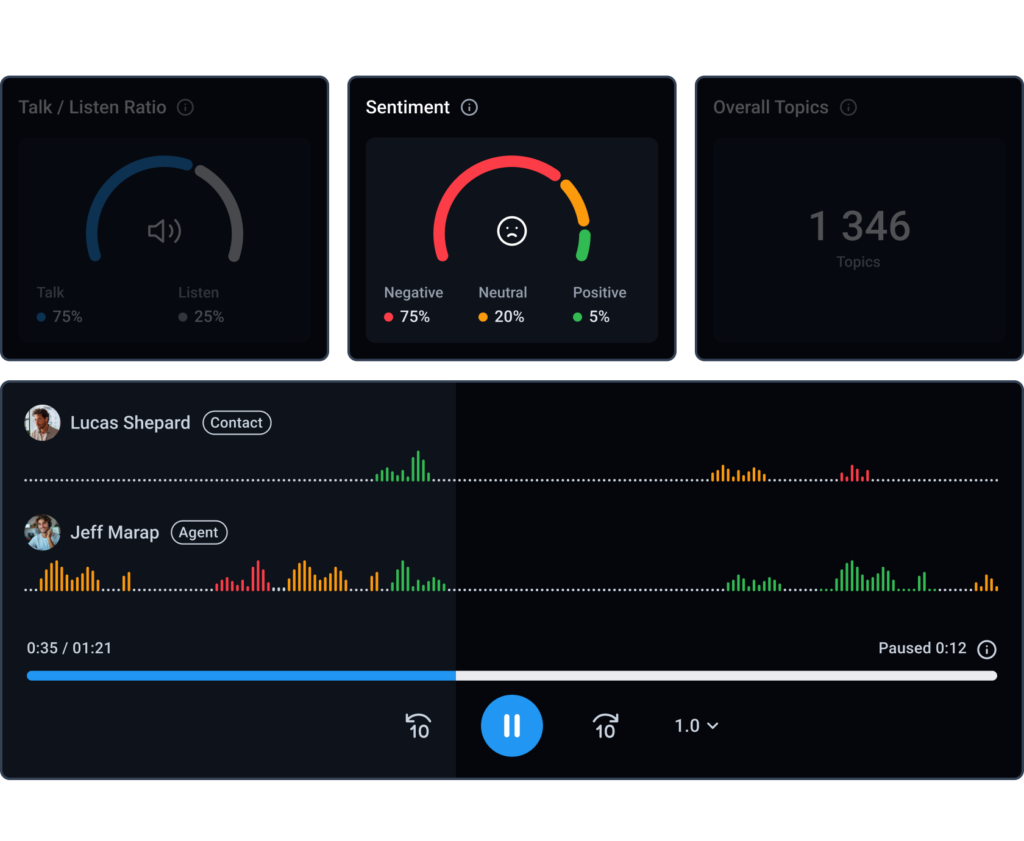
Knowing how your customers feel and what they need helps you tailor your products, services, and communication to meet their expectations. Tools like AI-powered sentiment analysis evaluate customer conversations to determine satisfaction levels and pinpoint pain points so you can respond proactively.
How it works:
Sentiment Analysis tools scan calls or messages for tone and keywords to identify whether customers are happy, frustrated, or at risk of churning. Imagine a customer repeatedly uses phrases like ‘disappointed’ or ‘poor service.’ The tool would flag the interaction, allowing your team to resolve the issue quickly.
Focus on the Best Opportunities
Chasing unqualified leads wastes valuable time and energy. In contrast, AI identifies patterns in customer behavior and engagement to predict which opportunities are most likely to convert so you can prioritize the ones that matter most.
How it works:
With AI Call Summaries, you can save up to 50% of the time agents would typically spend on after-call-work. Instead of reviewing lengthy recordings or taking manual notes, the summaries provide an immediate overview, enabling your team to focus on the most promising leads.

Predict the Future to Plan Ahead
Without accurate forecasting, it’s hard to plan effectively for demand and allocate resources where they’re needed. AI-driven predictive models use historical and real-time data to forecast trends, helping you prepare for what’s next.
How it works:
With Call Analytics, you can track data like call volume, total answered calls, and wait times. This helps you anticipate seasonal activity spikes and allocate resources effectively.

Improve Team Performance
Knowing your team’s performance helps you identify strengths and weaknesses, ensuring better focus and results. AI tools can analyze agent performance metrics, like call quality, response times, and success rates, to highlight areas for improvement.
How it works:
Agent Reporting tools track key metrics such as average call durations, resolution rates, and customer feedback, giving you the data you need to coach your team effectively and improve efficiency.

5 Steps to Implement AI Sales Forecasting Successfully
Now that you understand why AI sales forecasting is important and how it can impact your business, you might wonder where to start. Don’t worry, we’ve got you covered!
Follow these five steps to make the most out of it:
#1 Set Clear Goals
Define exactly what you want to achieve with AI forecasting—whether it’s predicting revenue, improving resource allocation, or optimizing inventory levels. Clear goals ensure AI focuses on solving the most pressing challenges.
#2 Prepare Data for AI Integration
Without a single source of truth, even the most advanced ai sales forecasting models will generate skewed predictions based on fragmented pipeline data.
AI relies on clean, organized data to deliver accurate predictions. That’s why you should unsure all your sales data, such as calls, CRM records, and emails, is consolidated, free of errors, and up-to-date.
#3 Choose the Right AI Tools
Choose AI tools based on your needs, such as improving accuracy or automating tasks, and ensure they offer features like trend detection and seamless CRM integration. Start with a trial to test their effectiveness before scaling up.
#4 Build and Train Your AI Model
Train your AI model using historical data, such as past sales figures, call records, and market trends. As new data comes in, your model learns and improves, creating forecasts that adapt to real-world changes.
#5 Establish a Feedback Loop
A feedback loop ensures your forecasts stay accurate over time. Continuously compare your AI’s predictions with actual results to identify gaps, refine the model, and improve its performance.
Recommended Articles
-
AI-Driven Customer Interactions
AI Sales Forecasting Challenges (And How to Overcome Them)
Implementing AI in sales forecasting offers significant advantages but also comes with challenges you need to be aware of. Learn about the most important challenges and their potential solutions:
Data Quality and Integration
If your data is incomplete, incorrect, or scattered across isolated systems, the results can be inaccurate. That’s why it’s essential to clean and unify data from different sources so AI can analyze it properly.
Solution:
Ensure your sales data includes recent information and is seamlessly connected to your CRM. This will enable predictions that accurately reflect the current reality of your business.
Adaptability to Market Changes
Market conditions change quickly: consumer trends, economic conditions, and other external factors can affect sales. If AI models aren’t designed to adapt to these changes, predictions can become less accurate. It’s crucial to monitor and update models continuously.
Solution:
Regularly update your AI models to reflect external changes, like new regulations or shifting consumer behaviors, ensuring the predictions remain relevant and actionable.
Integration of Qualitative Data
Incorporating subjective factors, such as brand perception or customer sentiment, remains a challenge for AI models. These elements are difficult to quantify, making their inclusion in forecasts complex.
Solution:
Combine quantitative data (sales figures, numbers) with qualitative analysis (customer opinions, social trends) to generate more comprehensive and precise forecasts.
Lack of Trust and Transparency
It’s not always easy to understand how AI algorithms arrive at specific predictions. This lack of transparency can lead to distrust and make decision-making more challenging. If you don’t understand how the predictions are generated, it’s hard to trust the results and act on them.
Solution:
Choose AI tools that provide clear explanations and data visualizations, making it easier to understand how the forecasts are generated and to build trust in the results.
3 Real-World Examples of AI Sales Forecasting
Does it sound too good to be true? Let us show you three real-life cases of businesses that achieved remarkable results by implementing AI sales forecasting:
Zalando’s Customer Service Chatbot
Zalando, a leading European online fashion retailer, implemented an AI-powered chatbot for customer service. The chatbot uses predictive analytics to anticipate customer needs, offering personalized shopping recommendations. By integrating these AI elements into the customer service framework, the company has improved the efficiency of its operations and created a more personalized and engaging shopping experience for its customers.
Starbucks’ Automated Email Campaigns
Starbucks utilizes AI in its sales and marketing strategies, particularly for automated email campaigns. The AI system analyzes customer data to understand buying habits and preferences, allowing Starbucks to create personalized email campaigns.
By segmenting customers based on behavior and predicting which offers they’re most likely to appreciate, Starbucks can more accurately forecast sales and tailor its marketing efforts.
Salesforce Einstein
Salesforce implemented Einstein Voice, an AI-powered tool that transcribes sales calls in real-time, identifies key topics, and assesses customer sentiment. Post-call, it provides actionable insights and personalized follow-up recommendations while leveraging predictive analytics to forecast customer behavior.
By implementing Einstein, sales teams can understand customer needs and plan targeted follow-ups. It enhances efficiency by reducing manual tasks and uses call data to predict trends, driving smarter, more personalized sales strategies.
What is an example of predictive forecasting in sales?
A common example of predictive forecasting in sales is using AI to analyze rep-customer phone conversations. The AI evaluates talk-to-listen ratios, objection handling, and caller sentiment to predict the exact likelihood of a deal closing. This allows sales managers to accurately forecast pipeline revenue based on actual conversation health, rather than relying on a rep’s gut feeling.
Upgrade Your Pipeline with AI Sales Forecasting
According to a study, 81%* of companies that used AI in sales forecasting reported improved sales and revenue forecasting accuracy. Missing from the conclusion / final CTA transition (A missed opportunity to tie the keyword directly to CloudTalk’s product-led solution). Suggested Sentence to Add: “Relying on manual spreadsheets limits your growth, but upgrading to ai sales forecasting gives your team the predictability they need to close deals faster.
Ready to see these results for yourself? With AI sales forecasting software like CloudTalk, using tools like Sentiment Analysis and Topic Extraction is simple. Book a demo today to get started.
Integrations allow agents to access customer data instantly and contextualize voicemail messages, leading to more personalized and informed responses.

Instant Insights Start Here

Sources:


