AI Customer Behavior Prediction: Is There an AI That Can Forecast Actions in 2026?
SUMMARY:
Predictive AI is the most effective way to stop customer churn before it happens. Instead of waiting for a customer to leave, businesses in 2026 use real-time conversational cues like tone and intent to prevent problems before they start.
How this guide helps you:
- 01Identify High-Intent Leads: Learn to detect buying signals during live calls to trigger instant sales follow-ups.
- 02Automate Retention: Discover how to flag at-risk customers weeks before they disengage.
- 03Scale with AI Voice Agents: See how CloudTalk’s AI Voice Agents act as active sensors to turn every interaction into actionable data.
- 04Navigate 2026 Regulations: Get a specific checklist for EU AI Act compliance and data residency for the German enterprise market.
Most businesses don’t lose customers because of bad service—they lose them because they didn’t see it coming!
That’s where AI customer behavior prediction changes the game. By analyzing patterns in tone, timing, and behavior across every interaction, it reveals what your customers are thinking, before they ever say it out loud.
It helps you reduce churn, spot upsell cues, and improve calls before your customers run away. And when powered by AI, those predictions become faster, smarter, and more precise.
This isn't just theory. In 2026, 86% of marketers already use AI-powered predictive analytics to anticipate behavior and drive smarter engagement.¹
Today, we’ll look at what AI customer behavior prediction is, why it matters, how it works behind the scenes, and how conversation intelligence turns insight into action.
Read Your Customers ... or Risk Losing Them
What is AI Customer Behavior Prediction? (Methods & Tools)
AI customer behavior prediction is the process of using artificial intelligence to analyze customer data (real-time and historical) and forecast likely actions. These actions could be churn, product upgrades, disengagement, or buying readiness.
It’s where consumer artificial intelligence meets actionable business insight.
Instead of guessing or reacting too late, AI models help you surface patterns that indicate intent, urgency, or risk. This gives your team the power to step in, like a private courier arriving, at exactly the right moment.
AI draws from a wide range of data sources, including:
- Historical data: past purchases, subscription activity, support tickets, login frequency
- Behavioral signals: clickstreams, session duration, scroll depth, bounce rates
- Contextual inputs: time of day, location, device type, even weather
- Conversational insights: tone, keywords, pace, and sentiment from calls or chats
These signals power models that detect both:
- Macro-level patterns like shared churn triggers across your customer base
- Micro-level cues like an individual user showing a high intent to upgrade
With tools like Conversation Intelligence and AI Smart Notes, you can put these predictions directly into action, without relying on guesswork or manual reviews.
Most leaders aren't just looking for definitions; they are looking for specific capabilities. Here is exactly what modern AI models can forecast for your revenue pipeline today.
What Can AI Predict? Churn, Upsells, and Campaign Triggers
AI doesn’t just monitor behavior—it anticipates what your customers will do next. Here are five high-impact predictions you can act on immediately:
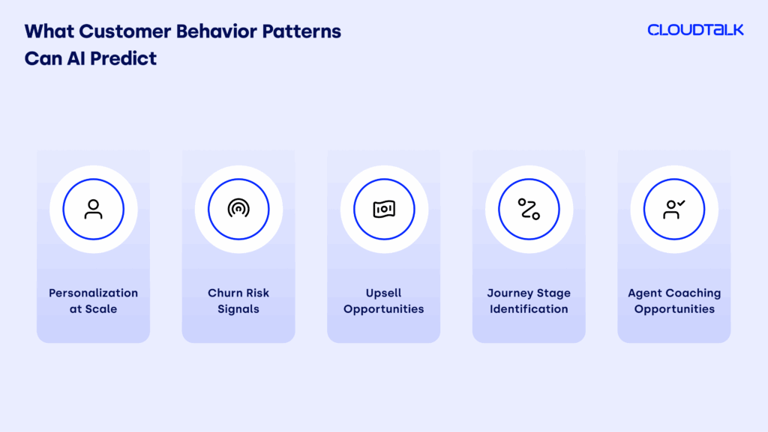
- Personalization at Scale: Tools like Preferred Agent routing ensure loyal customers hear a familiar voice, while AI-assisted messages adjust to their behavior and lifecycle stage.
- Churn Risk Signals: Early signs like fewer calls, reduced talk time, or negative sentiment can flag at-risk customers. This means you should use predictive Dashboards to help your team respond and prevent churn before it’s too late.
- Upsell Opportunities: AI Voice Agents detect interest signals (such as tone shifts or upgrade questions), helping your team act while intent is high. This is where AI Voice Agents bridge the gap between insight and action. Instead of waiting for a human rep to find a lead in a dashboard, an AI agent can automatically reach out to customers showing high purchase intent, handling initial inquiries, or scheduling demos instantly.
- Journey Stage Identification: Know who’s onboarding, ready to buy, or due for renewal—then personalize your approach accordingly.
- Agent Coaching Opportunities: AI insights improve agent performance too. Call Center Voice Analytics flags coaching moments using talk ratios, pacing, and sentiment.
<strong>Pro-Tip:</strong>
In 2026, we are moving from "Predictive" to "Agentic" commerce. Instead of just flagging a customer who might buy, advanced AI agents can now act on that prediction by offering a personalized discount or scheduling a call autonomously.
Companies that integrate these "digital employees" report higher execution reliability compared to those that just monitor dashboards.
Predict to Get Ahead
Predictive Analytics for Business: Why AI Forecasting Matters
AI forecasting is a powerful revenue driver. According to Forrester, B2B companies that use predictive tools grow their revenue 2.9x faster than their competitors.²
Imagine trying to drive through fog with no headlights. That’s what it’s like managing customers without predictive insights. You’re reacting late, missing cues, and risking churn at every turn.
AI customer behavior prediction turns on the high beams. It gives your team the foresight to:
- Flag churn risk and trigger proactive retention steps
- Detect upsell and cross-sell opportunities in real time
- Route conversations based on intent, journey stage, or sentiment
- Reduce guesswork across sales, support, and success teams
Most importantly, having that level of insight helps you drive revenues. And many businesses already leverage that.
And this isn't just theory. Nokia, for instance, used CloudTalk Analytics to improve customer insights and streamline operations at scale.
Predict Smartly, Just Like Nokia
SEO Insight:
In 2026, zero-click experiences (i.e., where users get answers directly in AI Overviews) have become the majority of search journeys.
To win here, your data must be structured as "Conversations," not just static answers. Using AI to predict the next three questions a customer will ask is the key to maintaining visibility in an AI-first search landscape.
Key Benefits of Predictive AI Models for Large Enterprises
When businesses can anticipate what customers are likely to do next, every team becomes more proactive, personalized, and precise.
Here's how predictive analytics in customer service and sales can drive real-world impact for your company:
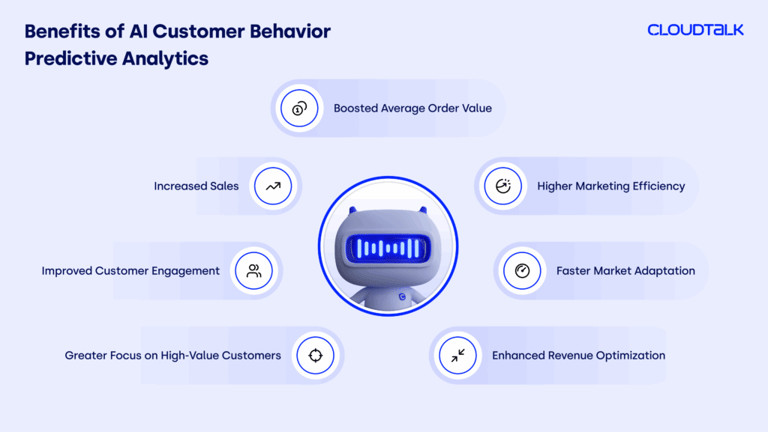
- Increased Sales: Predictive insights help reps focus on high-intent leads instead of cold ones. Tools like AI Smart Notes highlight what matters most, so deals close faster.
- Improved Customer Engagement: Features like Sentiment Analysis flag early signs of disengagement—like frustration or silence—so your team can act before customers leave.
- Enhanced Revenue Optimization: Some customers are ready to buy, others are close to churn. Call Summary Tags help you prioritize the right leads and boost revenue.
- Greater Focus on High-Value Customers: Predictive modeling helps you identify VIPs early. And the best thing? With tailored support or special offers, you build long-term loyalty and LTV.
- Faster Market Adaptation: AI reveals trends—like how new features or pricing shifts are received—before they spike. Use voice analytics and turn this feedback into action.
- Higher Marketing Efficiency: Customer behavior prediction helps you target the right leads at the right time. Predictive campaigns outperform broad ones and drive better ROI.
- Boosted Average Order Value: AI detects upsell or cross-sell signals in real time. AI predictive suites like CloudTalk help agents act instantly, growing cart size and improving customer satisfaction.
Test AI Behavior Prediction for Free
How it Works: AI Software that Predicts User Behavior (Step-by-Step)
While the results can feel like mind-reading, the backend actually follows a structured data pipeline.
This workflow turns raw customer signals into actionable business triggers through the following steps:
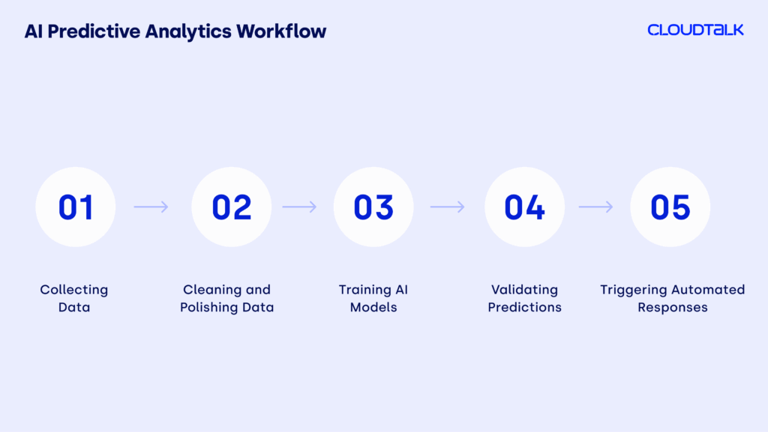
- Collect customer data: Pull insights from your CRM, call recordings, support tickets, chat logs, and website behavior. The more complete your data, the more accurate your predictions.
- Clean and structure your inputs: Remove inconsistencies, label key events, and format everything so your system can “read” it. AI only works as well as the data you feed it.
- Train AI models with real examples: Use past behaviors, such as what churned customers did in the weeks before they left, to teach your model what warning signs to look for.
- Test predictions against real outcomes: Compare what the model predicts with what actually happens. This helps you improve accuracy and reduce noise.
- Trigger automated responses: Once the system spots high-risk or high-value behavior, define what happens next: flag a rep, send a follow-up, or adjust the customer journey automatically.
Implementing Predictive Customer Behavior Models in 5 Steps
You don’t need a data team to get started. Here’s how you build a proactive system step by step:
1. Define Clear Objectives
Before you dive into dashboards or datasets, get clear on what you want to predict.
- Are you trying to reduce churn?
- Do you want to spot upsell opportunities?
- Is improving post-call satisfaction scores your main target?
Setting these objectives early ensures your data strategy is focused and aligned with your business goals. For example, if your goal is churn prevention, your AI model needs access to indicators like repeat complaints, call sentiment, or resolution speed.
2. Choose the Right Tools
Not all AI platforms are created equal. Look for solutions that offer:
- Built-in Natural Language Processing (NLP)
- Seamless integration with your CRM, help desk, and call tools
- Real-time analytics dashboards
This is why you should switch to a proven AI-powered call center. The best ones come with modern tools like AI Smart Notes, Sentiment Analysis, and AI Phone Answering Systems (i.e., AI virtual receptionists), offering SMBs what they need to stop reacting and start predicting.
Comparison Checklist for Enterprise Platforms (Germany/EU Focus)
When evaluating predictive models for the DACH region, standard software isn't enough. Ensure your platform meets these 2026 standards:
- EU AI Act Readiness: Ensure the tool identifies its risk category. Most customer service AI is considered "low risk," but you must prepare for strict transparency requirements taking effect in August 2026.
- Local Data Residency: Data must be processed within the EU to avoid aggressive GDPR damage awards, which are rising in Germany.
- Language & Cultural Nuance: Since 76% of shoppers prefer buying in their native language, your AI must be able to predict sentiment accurately across German dialects and formal/informal (Sie/Du) shifts.
- Proactive Transparency: European winners in 2026 use "proactive honesty", using AI to alert customers about outages or delays before the customer notices.
For many businesses, the most effective entry point is an integrated AI phone system. Unlike standalone analytics software that requires a data scientist, AI Voice Agents come pre-trained to recognize behavioral patterns and sentiment during live calls, turning every conversation into structured data automatically.
3. Gather and Prepare Data
Your AI model is only as good as the data you feed it. Focus on collecting accurate, consistent first-party data from systems like:
- CRM (e.g., lead status, deal/pipeline velocity)
- Website (e.g., page views, form completions)
- Call Center Dashboards (e.g., call duration, talk-to-listen ratios, transcript insights)
Oh, and don’t forget to structure and label this data to speed up model training and reduce noise.
4. Train and Test Models
When training and testing AI models, you no longer have to rely on data science partners, who often cost you a lot of resources. Instead, you can lean on AI-ready platforms to do the heavy lifting for you … at a much lower cost!
AI helps you use historical and real-time call data to generate smart customer behavior predictions and flag customer behavior patterns without requiring in-house model development.
5. Iterate and Improve
AI is not a “set it and forget it” solution. As customer behavior evolves, so must your prediction models.
Keep feeding new data into your system—especially from feedback loops like support surveys, call transcripts, or sales outcomes—using data pipeline tools to efficiently process and integrate this information, helping to refine prediction accuracy over time.
No Data Science Degree Needed
Deep Dive: AI Consumer Behavior Prediction & Modeling
For organizations looking to scale, understanding the engine behind the results is essential for long-term accuracy.
While the impact of AI customer behavior prediction is easy to see through better conversions and lower churn, the real power lies in how multi-layered analytics and automation work behind the curtain.
The Three Layers of AI Predictive Analytics
To understand how AI predicts customer behavior, it’s helpful to break it down into three core layers, each answering a different type of question about your customers.
- Descriptive Analytics (what happened): This layer summarizes historical data to identify patterns and trends. For example, it might show that many churned customers previously had unresolved support tickets or shorter-than-average calls.
- Predictive Analytics (what will likely happen): Based on previous behaviors, AI models forecast what actions a customer might take next, whether it’s a purchase, upgrade, or churn event.
- Prescriptive Analytics (what should you do about it): Here, AI recommends or automates the next best action. In other words, it lets you know whether to escalate a support case, prioritize a lead, or assign a preferred agent.
What AI Models Are Trained On
To produce accurate predictions, AI models are trained on rich, real-world customer data, which they gather from multiple touchpoints across your operation:
- Browsing and purchasing history: Tracks product views, cart activity, purchase frequency, and time on site.
- Call transcripts from tools like Call Recording: Analyze conversation content and tone for intent, objections, or sentiment shifts.
- Campaign engagement logs: Includes opens, clicks, and responses to emails or ads, helping map buying interest.
- Customer service interactions: Measures resolution time, escalation frequency, and satisfaction levels for behavioral insights.
Challenges & Solutions for Predictive AI Analytics Platforms
AI customer behavior prediction delivers big wins—but getting started can feel daunting, especially for SMBs. The good news? Most roadblocks are fixable with the right tools and strategy.
Here are the four most common challenges and their solutions:
1. Data Silos
Challenge: Your customer data lives across CRMs, helpdesks, and voice tools, making it hard to get a unified view. Without integration, predictions fall flat.
Solution: Break down the silos. Integrate CRMs and support platforms to unify voice, behavioral, and transactional data—fueling smarter models and smoother automation.
The German Enterprise Gap:
In Germany, standard marketing consent rates have plummeted as users increasingly opt out of third-party tracking. To maintain accuracy without crossing ethical lines, leading firms are moving toward Privacy-Safe AI.
This approach uses first-party conversational data (e.g., the tone and sentiment of a call), rather than invasive cookies. This allows for hyper-personalization while remaining fully compliant with the EU AI Act, which becomes fully applicable by August 2026.
2. Model Bias and Inaccuracy
Challenge: Old or unbalanced data leads to inaccurate predictions—and even reputational risks.
Solution: Make data audit a routine. Use tools that provide call-level transparency so you can refine models, compare predictions with outcomes, and ensure your AI stays fair—especially with real-time analytics built for voice data.
3. Limited Internal Expertise
Challenge: No data scientists on staff? That’s pretty normal—and for many SMBs, even scary.
Solution: Start simple. Look for AI solutions like CloudTalk that incorporate Analytics and Real-Time Dashboards to surface predictive insights from day one. No steep learning curve required.
4. Cost and Scalability Concerns
Challenge: AI sounds expensive, and SMBs often worry about ROI.
Solution: To keep budgets under control, start testing with a focused use case, like churn reduction or lead scoring. Look for AI solutions that offer flexible pricing and modular features, letting you start small, prove impact, and scale with confidence.
By using AI Voice Agents to handle routine predictions (e.g., identifying which callers are at risk of churn), you reduce the burden on your high-cost human resources. This allows you to scale your predictive capabilities without a 1:1 increase in headcount.
Recommended articles
Conclusion: Don’t Just React to Your Customers, Predict and Win Them with AI
Winning companies in 2026 prioritize prediction over reaction. Waiting for a customer to speak up or churn before taking action means you are already behind the competition.
CloudTalk helps you bridge this gap today. Our AI-powered suite includes intelligent AI Voice Agents that turn raw data from calls and CRM entries into clear next steps.
By automating outreach based on these predictions, you can boost revenue, retention, and customer satisfaction at the same time.

Don't Just React - Predict

Sources:
- Best AI Marketing Statistics
- How Predictive Marketing Analytics Boosts B2B
Frequently asked questions
Yes. Modern predictive analytics for business allows you to use AI to analyze historical data and real-time signals. This technology helps companies forecast future actions like purchases or churn with high accuracy.
CloudTalk is a primary example of AI software that predicts user behavior. By using Conversation Intelligence to detect intent during live calls, CloudTalk automatically sends data to your CRM to trigger personalized marketing campaigns or follow-up sales tasks.
Yes. AI models identify churn risk signals by monitoring declining call frequency, shorter talk times, and negative emotional cues. This allows your team to intervene with proactive retention strategies weeks before a customer leaves.
The best predictive customer behavior modeling tools for enterprises in Germany prioritize GDPR compliance and EU AI Act readiness. Solutions like CloudTalk process data within the EU and use first-party conversational insights instead of invasive third-party tracking.
Yes. AI models analyze micro-level cues during interactions, such as specific questions about pricing or integration. CloudTalk’s AI Voice Agents detect these signals instantly and flag high-intent leads for immediate sales follow-up.
AI uses predictive analytics business applications to segment users based on their past interactions. It forecasts their next likely move so you can deliver the right offer through automated triggers at the exact moment they are ready to engage.
Yes. Sentiment analysis tools scan voice and text for emotional shifts. CloudTalk’s real-time analytics alert managers to potential frustration in a call, allowing for live intervention before the customer experience turns negative.
As of February 2026, companies must prioritize transparency. By the August 2026 deadline, most AI systems in customer service must be clearly disclosed so users are aware they are interacting with an AI-powered tool.
Absolutely. CloudTalk’s AI Voice Agents act as active sensors during every conversation. They gather data and act on predictions in real time by routing calls to preferred agents or providing instant answers to resolve potential churn.
In 2026, the most searched queries focus on "is there an AI that can" automate lead scoring and predict which prospects are most likely to close. These high-intent searches drive the shift toward integrated predictive platforms like CloudTalk.